

Below executive-summary paragraphs adding market data for China, Indonesia, South Korea, Japan, Malaysia, UAE, Hong Kong, Singapore, Qatar, and Egypt.
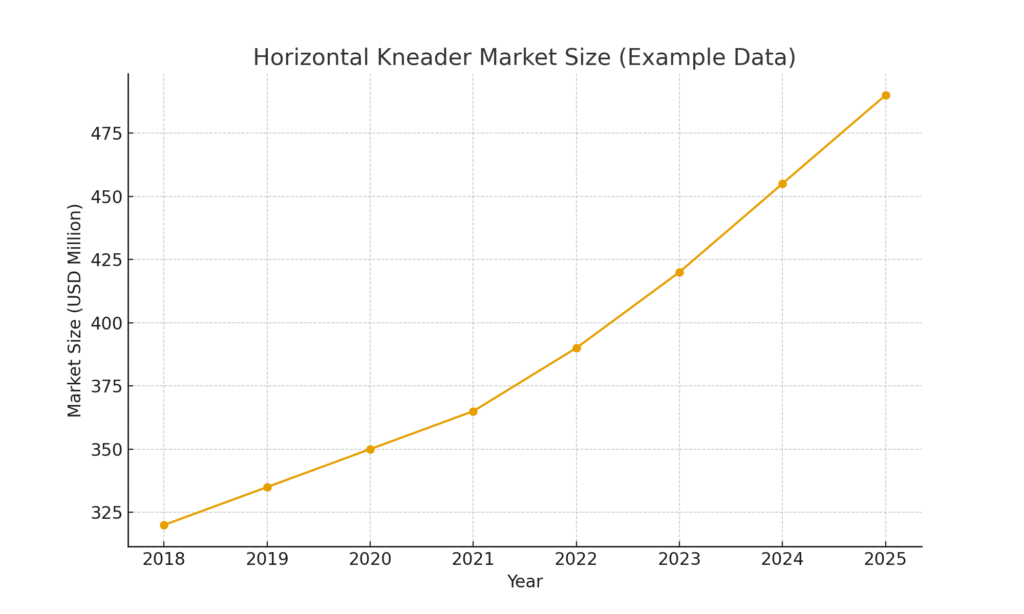
Horizontal Kneader Market size was valued at USD 300 Million in 2024 and grow at a CAGR of 5.1% from 2026 to 2033, reaching USD 450 Million by 2033.
The global Horizontal Kneader market has been experiencing steady growth, supported by rising demand from chemical processing, rubber and plastics manufacturing, food production, and pharmaceutical sectors. In 2023, the market size is estimated at USD 1.2 billion, and it is projected to reach USD 2.3 billion by 2032, reflecting a strong CAGR of about 7–8% over the forecast period. The Asia-Pacific region remains the dominant hub, contributing nearly 35% of global revenue.
Within this region, China alone accounts for about 12% of the total market value, driven by its expansive industrial base, while Japan and South Korea collectively contribute around 7–8%, supported by advanced manufacturing sectors. Indonesia and Malaysia, though smaller markets at roughly 2–3% each, are growing quickly due to accelerating industrialization and increased investment in polymer and rubber processing.
In the Middle East and Africa, countries such as the UAE, Qatar, and Egypt together represent 3–4% of global demand, with growth tied to petrochemical expansion, construction materials, and infrastructure projects. Smaller but high-value Asian markets such as Singapore and Hong Kong contribute another 1–2%, largely due to demand for precision equipment in specialty chemicals, electronics materials, and high-purity manufacturing.
The Horizontal Kneader Market has experienced significant growth trajectory, driven by evolving consumer insights and emerging markets. A comprehensive market analysis and competitive intelligence highlight key challenges, opportunities, and differentiators, while benchmarking against top competitors provides actionable recommendations for enhancing market penetration and share of market.
Utilizing data-drivenmetrics, including KPIs and quantitative analysis, supports predictive analysis of revenue streams, profitability, and ROI. Effective distribution channels, product portfolio optimization, and service offerings aligned with customer journey insights ensure improved operational efficiency, scalability, and organizational impact.
Strategic frameworks, SWOT analysis, and thought leadership inform strategic initiatives, tactical approaches, and workflow optimization, enabling alignment with global trends, value proposition, and long-term potential. Innovation, integration, and analytical rigor drive measurable outcomes, reinforcing brand positioning, market dynamics, and overall business intelligence.
Download Sample: https://www.verifiedmarketreports.com/download-sample/?rid=503014&utm_source=Linkedin&utm_medium=337
Despite the positive outlook, the market faces notable challenges, including high capital investment for advanced machinery and elevated energy and maintenance costs, which can slow adoption in cost-sensitive regions such as Indonesia, Malaysia, and Egypt. Volatility in metal and component prices also poses risks to equipment manufacturers.
Nevertheless, significant opportunities exist: China, Japan, and South Korea continue to demand high-precision kneaders for electronics and engineered materials; the UAE and Qatar are expanding capacity for petrochemical intermediates; and Southeast Asian countries are developing new industrial clusters requiring durable, efficient mixing solutions. With growing focus on energy-efficient systems, customization, and Industry 4.0-ready equipment, the Horizontal Kneader market is positioned for strong long-term expansion across both mature and emerging regions.
Market Introduction
Horizontal kneaders are available in several configurations to accommodate material characteristics and processing goals. Sigma kneaders are the most common type, equipped with sigma-shaped blades ideal for intensive kneading of sticky or elastic materials. Double-arm kneaders feature two counter-rotating blades designed for heavy-duty mixing of viscous compounds, rubber-like materials, and chemically reactive mixtures. Twin-shaft horizontal kneaders provide enhanced shear and rapid dispersion for high-volume industrial applications, while tilting or discharge-extruder kneaders facilitate easier product removal and continuous operations.
These machines serve critical roles in a wide range of industries: in the chemical sector, they are used for dyes, pigments, resins, and sealants; in rubber and plastics, they support compounding, masterbatch production, and elastomer processing; in food manufacturing, they handle confectionery masses, doughs, and thick pastes; in pharmaceuticals, they aid in wet granulation and controlled compound mixing; and in the adhesives and sealants industry, they ensure homogeneous blending of reactive and high-viscosity formulations.
The value chain of the horizontal kneader market spans multiple interconnected stages. It begins with raw material suppliers, providing steel, alloy components, motors, gearboxes, electronic controls, and specialized blades. Manufacturers then design, assemble, and test kneader units with engineering customization to meet industry-specific requirements. This is followed by distributors and system integrators, who support equipment installation, process optimization, and application engineering. End users—spanning chemicals, plastics, pharmaceuticals, food, construction materials, and adhesives—deploy these machines within high-intensity production environments.
Impact of AI on the Horizontal Kneader Market
The integration of artificial intelligence (AI) and machine learning is beginning to transform the horizontal kneader market by enabling smart, data-driven manufacturing processes. AI-powered systems allow real-time monitoring of mixing and kneading operations, predictive maintenance, and process optimization, which significantly reduces downtime and improves product consistency.
In advanced manufacturing regions such as Japan, South Korea, Singapore, and Hong Kong, AI-enabled kneaders are increasingly being deployed to handle complex, high-viscosity materials and specialty compounds with minimal human intervention. This capability not only increases operational efficiency but also supports leaner production lines and better energy management, addressing some of the traditional constraints of high energy consumption and maintenance costs.
Furthermore, AI facilitates adaptive process control, where kneaders can automatically adjust speed, temperature, and mixing intensity based on material properties or batch requirements. This is particularly valuable in industries such as pharmaceuticals, food processing, and specialty chemicals, where precision and compliance with regulatory standards are critical.
In emerging markets like China, Indonesia, Malaysia, Egypt, UAE, and Qatar, AI adoption is gradually increasing as manufacturers seek competitive advantage through automation and process optimization. Overall, AI integration is expected to accelerate market growth, enable predictive analytics for better resource utilization, reduce operational costs, and create opportunities for smart, connected kneader systems tailored to both mature and emerging industrial markets.
Market Dynamics
A. Drivers
The horizontal kneader market is being strongly propelled by industrial automation and process-optimization efforts across key manufacturing hubs, especially in East and Southeast Asia and the Middle East. In China, rapid scale-up in chemical and plastics manufacturing, coupled with the government’s push for “smart factories,” is significantly raising demand for high-efficiency mixing equipment such as horizontal kneaders.
Similarly, in South Korea and Japan, the drive toward leaner, more precise manufacturing processes in specialty polymer and rubber compounds is encouraging adoption of advanced kneading systems. Indonesia and Malaysia, with their growing plastics downstream sectors, are increasingly investing in automated kneading machinery to improve product uniformity and throughput. In the Middle Eastern markets — UAE and Qatar — expansion of chemical-processing capacity and petrochemical downstream integration is driving demand, while in Egypt, emerging industrial clusters are gradually modernizing, which supports uptake of horizontal kneaders.
Moreover, technological advancements in mixing and kneading equipment are providing strong tailwinds across these geographies. In Singapore and Hong Kong, which are regional hubs for R&D and high-tech manufacturing, companies are deploying more sophisticated kneader machines that incorporate digital monitoring, energy-efficient drive systems, and modular designs.
These innovations reduce operating costs and improve consistency, making them increasingly attractive in Japan, South Korea, and China. Across the Middle East and North Africa (including UAE, Qatar, and Egypt), these technology-driven kneaders enable local producers to compete more effectively on quality by matching global standards. As manufacturing capacity expands in Indonesia and Malaysia, firms there are also adopting next-generation horizontal kneaders, reinforcing growth driven by both scale-up of production and process sophistication.
B. Restraints
The horizontal kneader market faces notable restraints, primarily stemming from high capital and maintenance costs, which disproportionately affect emerging and cost-sensitive markets. In countries such as Indonesia, Malaysia, and Egypt, manufacturers often operate with tight capital budgets, making it challenging to invest in advanced kneading systems that require significant upfront expenditure and specialized maintenance.
Even in more developed manufacturing environments like China, South Korea, and Japan, the sophisticated features of modern horizontal kneaders—such as automated controls, heavy-duty components, and integrated monitoring systems—raise long-term ownership costs, prompting some producers to delay equipment upgrades. In the UAE and Qatar, although industrial expansion is ongoing, the preference for equipment with lower operating complexity can hamper adoption when total lifecycle costs appear high compared to return on investment.
Energy consumption concerns further constrain market growth, particularly in highly industrialized regions where power prices are elevated or environmental regulations are tightening. Countries such as Japan, Singapore, and Hong Kong emphasize energy efficiency in manufacturing, making energy-intensive kneader systems less attractive unless they can demonstrate clear cost savings.
Meanwhile, the availability of low-cost alternatives, especially in China’s vast machinery ecosystem, creates stiff price competition; locally manufactured, lower-spec equipment often appeals to smaller factories in China, Southeast Asia, and the Middle East. This dynamic limits penetration of higher-end horizontal kneaders in markets like Egypt and Indonesia, where affordability outweighs performance benefits. Collectively, these restraints challenge manufacturers to balance cost, efficiency, and functionality while aligning with each country’s industrial maturity and investment capacity.
C. Opportunities And Challenges
The horizontal kneader market is poised for significant opportunity as industries across Asia and the Middle East increasingly embrace smart, IoT-enabled manufacturing equipment. In technologically advanced economies such as Japan, South Korea, Singapore, and Hong Kong, there is strong demand for connected machinery capable of predictive maintenance, remote monitoring, and real-time optimization.
This trend is also gaining traction in China, where digital industrialization initiatives are accelerating automation across plastics, rubber, and chemical processing facilities. Additionally, the push toward green and energy-efficient machinery is creating opportunities for equipment makers to differentiate with low-consumption, high-performance kneader designs—particularly in markets with rising energy prices or sustainability goals, such as Japan, Singapore, and the UAE.
The growing production of specialty chemicals and high-viscosity materials across Indonesia, Malaysia, Qatar, and Egypt further supports demand for advanced kneaders with precise control capabilities, reinforcing market expansion across both mature and emerging industrial clusters.
However, the market also faces persistent challenges that could limit adoption. Volatility in raw material prices, especially steel, alloys, and precision components used in kneader manufacturing, can disrupt pricing strategies and dampen investment appetite in more budget-sensitive countries such as Egypt, Indonesia, and Malaysia. Additionally, strict regulatory standards in food and pharmaceutical applications pose hurdles in developed markets like Japan, South Korea, and Singapore, where equipment must comply with stringent hygiene, safety, and validation requirements.
This increases certification costs and lengthens market entry timelines for suppliers. Even in the Middle East, where pharmaceutical and food-processing investments are rising in the UAE and Qatar, meeting global compliance norms requires substantial customization and documentation. Together, these challenges heighten competitive pressure and demand continuous innovation to maintain market positioning.
Ask For Discount – https://www.verifiedmarketreports.com/ask-for-discount/?rid=503014&utm_source=Linkedin&utm_medium=337
Market Segmentation
By Product Type
- Single-screw horizontal kneaders
- Dual-shaft horizontal kneaders
- Sigma blade kneaders
By Capacity
- Small (laboratory scale)
- Medium
- Large (industrial scale)
By Application
- Chemicals
- Rubber and plastics
- Food and beverages
- Pharmaceuticals
- Construction materials
- Adhesives & sealants
- Others
By End-use Industry
- Manufacturing
- Chemical processing
- Food processing
- Pharmaceutical production
- Material compounding
By Region
- North America
- Europe
- Asia-Pacific
- Latin America
- Middle East & Africa
Competitive Landscape
Arcen Engenharia, B & P Process Equipment, BHS, Brabender, Dadaux, Erweka, Fibo Intercon, Komplet Italia, LCI, Liebherr Mischtechnik, Lutetia, Mori-Tem, Nanjing Hanrui Cobalt, Permix Tec, RPA Process, Semix Concrete Batching Plants, Shako, Shuanglong Group, Sicoma Sicoma, Simem Italia, Soilmec, SPX Flow Technology Copenhagen, VMI, Wirtgen, Zanelli, Zeppelin Silos & Systems
Competitive Strategies
In the horizontal kneader market, manufacturers are increasingly adopting product differentiation as a core competitive strategy, focusing on advanced design features, enhanced automation, and application-specific customization. Leading suppliers emphasize innovations such as variable-speed dual-shaft mechanisms, improved heat-management systems, and digital control interfaces to cater to end users in chemicals, plastics, pharmaceuticals, and food processing. Differentiation also extends to material construction—such as corrosion-resistant alloys or sanitary-grade components—to target regulatory-intensive sectors.
Across Asia and the Middle East, companies supplying to China, Japan, South Korea, Singapore, and the UAE emphasize tailored models for high-viscosity materials, specialty polymers, and precision mixing, while those operating in Indonesia, Malaysia, Egypt, and Qatar increasingly focus on durable, mid-range machines optimized for heavy-duty industrial throughput.
Pricing strategies remain highly influential, particularly in regions where budget sensitivity shapes purchasing decisions. Market leaders often employ tiered pricing—offering entry-level, mid-range, and premium horizontal kneader lines—to address the diverse needs of manufacturers across emerging and developed economies. Competitors in Asia’s manufacturing hubs frequently leverage cost-efficient production and supply-chain optimization to maintain competitive pricing without compromising performance. Alongside pricing, after-sales service and maintenance offerings have become a major differentiator.
Companies capable of providing rapid technical support, spare-parts availability, on-site diagnostics, and preventive maintenance programs gain stronger customer retention, especially in countries with expanding industrial bases such as China, Malaysia, Indonesia, Qatar, and Egypt. For advanced markets like Japan, Singapore, Hong Kong, and South Korea, long-term service contracts, remote monitoring, and predictive maintenance packages are increasingly essential to securing repeat business and sustaining brand credibility.
View Full Reports With Analysis: https://www.verifiedmarketreports.com/product/horizontal-kneader-market/
What our reports includes
Technology & Innovation Analysis
- Overview of mixing technologies
- Advancements in blade design and material engineering
- Energy-efficient and automation-integrated kneaders
- IoT/Industry 4.0 integration
- Safety and compliance innovations
Supply Chain & Manufacturing Insights
- Raw material sourcing
- Manufacturing processes
- Cost structure analysis
- Supplier and distribution channel insights
Regulatory & Standards Landscape
- International safety standards
- Food & pharmaceutical equipment certifications
- Environmental regulations affecting equipment design
Market Trends
- Adoption of automated mixing systems
- Growth in high-viscosity material production
- Custom-built kneader solutions
- Continuous mixing vs. batch mixing trends
Regional Market Outlook
Asia-Pacific
- Production expansion and cost advantages
Strategic Recommendations
- Market entry strategies
- Investment opportunities
- Product innovation roadmaps
- Partnership and distribution strategies
Wrap Up
The future outlook for the horizontal kneader market remains broadly positive, supported by ongoing industrial modernization, rising automation adoption, and steady growth in chemical, plastics, and high-viscosity materials processing. Countries such as China, Japan, South Korea, Singapore, and the UAE are expected to lead demand as manufacturers continue shifting toward smart, IoT-enabled machinery with higher precision, reliability, and energy efficiency. Emerging manufacturing bases in Indonesia, Malaysia, Egypt, and Qatar will also contribute to expansion as they scale up production capabilities and gradually incorporate more advanced mixing technologies. Overall, the market is projected to benefit from technological innovation, sustainability-driven equipment upgrades, and expanding applications in specialty chemicals, pharmaceuticals, and processed materials.
However, the competitive landscape will remain shaped by a balance of promising opportunities and persistent threats. Opportunities lie in the development of green and energy-efficient kneaders, advanced monitoring systems, and equipment tailored for complex, high-viscosity formulations. At the same time, challenges such as high capital and maintenance costs, energy consumption concerns, price sensitivity in emerging markets, volatility in raw material costs, and increasingly strict regulatory requirements—particularly in food and pharmaceutical applications—will pressure manufacturers to innovate while controlling costs. Companies that strategically differentiate their products, optimize pricing, and strengthen after-sales service networks across Asia and the Middle East will be best positioned to capitalize on growth while mitigating market risks.
FAQ
1. What are the key factors driving growth in the horizontal kneader market?
Answer: The market growth is primarily driven by increasing industrial automation, rising demand for high-viscosity material processing, technological advancements in mixing and kneading equipment, and expansion of manufacturing capacities in emerging economies.
2. Which regions are expected to show the fastest adoption of horizontal kneaders?
Answer: Asia-Pacific (China, Japan, South Korea, Indonesia, Malaysia) is expected to lead adoption due to industrial expansion and automation initiatives, while the Middle East (UAE, Qatar) shows growth from petrochemical and downstream chemical processing investments.
3. What are the main challenges restricting market growth?
Answer: High capital and maintenance costs, energy-intensive operations, price-sensitive end users, raw material price volatility, and stringent regulatory requirements in food and pharma applications limit adoption in some markets.
4. How is technology impacting the horizontal kneader market?
Answer: Advances such as IoT-enabled monitoring, predictive maintenance, energy-efficient drive systems, and modular designs are enhancing operational efficiency, reducing downtime, and improving process consistency, particularly in high-end manufacturing hubs.
5. What are the major opportunities for market expansion?
Answer: Opportunities include the growing demand for smart, connected kneaders, energy-efficient machinery, specialty chemicals and high-viscosity materials processing, and expansion in emerging markets where manufacturing modernization is underway.
6. How does market competition influence horizontal kneader adoption?
Answer: Companies differentiate via product innovation, pricing tiers, and robust after-sales services. High-quality service, technical support, and equipment customization are key factors influencing procurement decisions across different regions.
7. Which industries are the primary end users of horizontal kneaders?
Answer: Primary industries include chemicals, plastics, rubber, pharmaceuticals, food processing, and specialty materials where precise mixing, high shear, or uniform compound preparation is critical.
8. How do regulatory standards affect the market?
Answer: Strict regulations in food and pharmaceutical applications increase certification and compliance costs, lengthen approval timelines, and drive demand for hygienic, high-precision kneaders, especially in developed markets like Japan, South Korea, Singapore, and Hong Kong.
9. What role does energy efficiency play in purchasing decisions?
Answer: Energy consumption is a major consideration, particularly in developed economies with higher electricity costs or environmental mandates. Manufacturers prefer low-consumption machines to reduce operating costs and align with sustainability goals.
10. What strategies are companies using to maintain competitiveness in the market?
Answer: Key strategies include product differentiation, offering tiered pricing models, enhancing after-sales service and maintenance programs, leveraging technological innovation, and targeting market-specific applications to capture both mature and emerging markets.
